

Any serious study of civil procedure in the United States should learn from other procedural systems. Comparative study has a number of advantages. It can provide insights about alternatives. It can shed light on beneficial features of our own procedural system that we take for granted. And it can generate questions for further study.
In Hyrniak’s Erosion: Summary Judgment in Ontario, Suzanne E. Chiodo, Gerard J. Kennedy, & Alyssa King conduct an insightful and nuanced empirical study of summary judgment motions in Ontario provincial courts (the equivalent of state courts in the United States). The motivation for the study is a tension between two views of summary judgment. The first, endorsed by the Supreme Court of Canada in Hryniak v. Mauldin (2014), views summary judgment as a vehicle for increasing access to justice by reducing the costs of litigation. The central idea is that the amount of procedure should be “proportional” to the case, and in some lower-stake cases providing a full trial would be a form of “undue process,” raising costs and discouraging plaintiffs from filing suit. The second, endorsed by the Ontario Court of Appeals, discourages summary judgment because such motions are themselves costly and can hinder the “full appreciation of the evidence and issues” needed to resolve a case.
As someone who studies U.S. civil procedure, a few things jumped out to me. First, Ontario’s summary judgment standard is a bit looser than the “no genuine dispute as to any material fact” standard for U.S. federal courts, which prohibits the judge from evaluating conflicting evidence. In U.S. federal courts fact-finding is usually the jury’s job, and in some cases constitutionally required. Ontario employs a summary process that allows a judge “to engage in a live fact-finding hearing and weigh significant amounts of evidence.” Second, summary judgment in Ontario is de facto at the discretion of the court. In U.S. federal courts a party “may move for summary judgment” without leave of court. Parties in Ontario’s provincial court “must appear before a motions scheduling court . . . in order to schedule a summary judgment motion.” According to a report by the Civil Rules Review Working Group, convened by the Ontario Attorney General and the Chief Justice of the Ontario Superior Court of Justice, “courts in certain regions have started refusing to schedule summary judgment motions . . . despite lacking explicit authority to do so.” And in Ontario one judge may decide whether to schedule a summary judgment motion while a different judge decides the motion itself.
Chiodo, Kennedy, and King study the hearing and disposition of summary judgment motions in Ontario, creating a data set based on Westlaw searches designed to capture the universe of summary judgment motions resolved from 2015 to 2024. The authors sought to measure the effects of Hyrniak on the provincial courts, as well as the observed dip in motions resolved during the pandemic around 2020. This highlights another feature of Canadian civil procedure. Courts in the United States provide publicly available dockets; regardless of one’s feelings about PACER, almost all docket entries in the federal system and most state court systems are presumptively available to the public. Not so in Canada. The authors could not measure the number of summary judgment motions filed, and thus the study “offers limited insight into the behavior of parties.” Instead, the authors were limited to those summary judgment decisions reported on Westlaw, with the data set used by the Civil Rules Review Working Group serving as a check.
The authors found that Hyrniak did have an effect in increasing the number of summary judgment decisions in Ontario courts. But when the pandemic slowed all decisions; the number of summary judgment decisions never recovered. Figure C from the study shows this difference, with the key pivot in 2020.
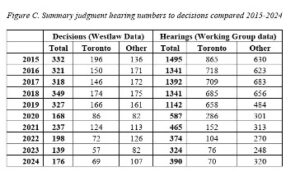 In addition to the decrease in numbers, the percentage of summary judgment grants increased, suggesting that “courts are not only hearing fewer motions, but ones that are safer.” Here we may be getting some insight into party behavior. Given the cost of summary judgment motions, parties may be self-selecting, filing when they are more certain of prevailing. Alternatively, scheduling courts may be weeding out summary judgment motions that are unlikely to prevail. The authors do some further nuanced analysis of the data set with respect to appeals, regional differences, the time to decision, and the effect of legal representation.
I like this study lots. It provides a window into summary judgment as an “access to justice” device, opening up alternatives such as “mini-trials” that may be viable in the United States with some creativity (e.g., bellwether trials in multidistrict litigation). More broadly, the concept of “proportionality” introduces the possibility of too much, or “undue,” process, requiring courts to create streamlined processes for smaller cases. U.S. courts and scholars should take that concept seriously. The study also highlights how lucky we are in the U.S. to have publicly available information about the courts. Finally, its sensitive analysis of the data suggests some interesting avenues of further study, such as party responses to procedural vehicles more generally and the effects of procedure on ex ante behavior.




Trackbacks/Pingbacks